
Why the people most afraid of losing control are usually the ones least likely to
Written by Armaan Raheja, Founder of breakOCD | Clinically reviewed by Dr. Sachi Pandya, Psychologist, Mumbai
In This Article
What if I snap? What if I lose control and do something terrible? What if I cannot trust my own mind? If these questions live in your head, this article is for you.
The fear of losing control is one of the most common and most distressing experiences in OCD. It is also one of the most misunderstood, both by the people experiencing it and by those around them.
It can show up as a fear of acting on a violent thought. A fear of saying something deeply offensive in public. A fear of losing your grip on reality and doing something you would never choose to do. A fear of your own impulses, your own mind, your own hands.
These fears feel urgent and real. And they are almost always accompanied by a profound sense of shame, because the person experiencing them is typically someone who cares deeply about the safety and wellbeing of others. They are not dangerous. They are frightened.
Understanding what this fear actually is, where it comes from, and what the research tells us about it, is often the first step toward loosening its grip.
What the Fear of Losing Control Actually Means in OCD
In OCD, the fear of losing control is not a single subtype with a single form. It is better understood as an underlying fear that runs through many different OCD presentations.
Research published in the journal Cognitive Therapy and Research describes fear of losing control as relevant across multiple anxiety presentations, with specific features that are particularly associated with OCD. In OCD, the fear tends to center on the belief that losing control over one's thoughts will lead to losing control over one's behavior. In other words: if I cannot stop thinking this thought, I might act on it.
This belief, that thought leads to action, is one of the core cognitive distortions that drives OCD forward. It is also, clinically, not true. But the fact that it is not true does not make the fear less real or less painful.
The fear of losing control in OCD typically takes one of several forms:
Fear of acting on violent or aggressive intrusive thoughts, such as harming a family member, a stranger, or a child
Fear of saying something deeply inappropriate, offensive, or hurtful in a social setting
Fear of losing control of the car while driving and causing an accident
Fear of acting on unwanted sexual thoughts or impulses
Fear of losing control of one's emotions and behaving in a way that is completely out of character
Fear of losing contact with reality or going mad
What these forms share is not the specific feared outcome but the underlying mechanism: a thought arrives that is experienced as a potential command, and the person cannot tolerate the uncertainty of not knowing whether they will act on it.
The fear of losing control in OCD is not about being dangerous. It is about being unable to tolerate any uncertainty about one's own safety as a person. That is a very different thing.

The Irony at the Heart of This Fear
There is a well-established clinical observation about the fear of losing control in OCD that is worth stating directly, because it is the most important thing to understand about this experience.
The people most terrified of acting on a violent or harmful thought are among the people least likely to ever act on one.
This is not reassurance. It is a clinically observed pattern with a clear explanation.
OCD targets what matters most to a person. If you are someone who cares deeply about the safety of others, who would be horrified at the thought of causing harm, whose entire moral world is organized around protecting the people you love, then OCD will find that value and attack it directly. The thought will be about harm. The fear will be of losing control. The distress will be enormous, precisely because the possibility of acting on the thought is so utterly contrary to who you are.
A person who genuinely wanted to cause harm would not be terrified of the thought of doing so. They would not be spending hours analyzing the thought, avoiding situations, seeking reassurance, or lying awake at night trying to prove to themselves that they are safe.
The distress is the evidence. The horror you feel about the thought is not a warning sign. It is proof that the thought goes against everything you stand for.
In OCD, the intensity of the fear about a thought is not evidence that the thought is dangerous. It is evidence that it matters to you. Those are completely different things.
What the Research Tells Us
Two important lines of research are particularly relevant to understanding this fear.
The first comes from experimental studies on beliefs about losing control in OCD. Research published in Behaviour Research and Therapy found that when participants were given false feedback suggesting that having intrusive thoughts meant they were likely to lose control over their behavior, they experienced significantly more anxiety and intrusive thoughts when asked to approach feared stimuli, like sharp knives, compared to participants who were told that intrusive thoughts are normal. In other words, the belief that thought leads to action is itself what makes the fear so powerful. It is not an accurate reflection of risk. It is a cognitive appraisal that amplifies anxiety and drives compulsive behavior.
The second line of research, published in Cognitive Therapy and Research in 2025, examined whether fear of losing control is specific to OCD or present across anxiety conditions. The findings confirmed that fear of losing control is elevated in OCD, and that the specific fear of losing control over thoughts and behavior, as opposed to bodily sensations, is particularly associated with OCD presentations. This matters clinically because it means that treatments for OCD need to specifically address the belief that thoughts can cause behavior, not just the anxiety itself.
What both lines of research confirm is that the fear of losing control in OCD is a cognitive phenomenon driven by a specific and inaccurate belief. That belief can be changed with the right treatment.
How This Fear Shows Up in Indian Families and Communities
In India, the fear of losing control takes on particular dimensions that are shaped by cultural context and deserve to be named directly.
Fear of harming family members
In a culture where family is everything and the bonds between family members are among the deepest sources of meaning in a person's life, the intrusive thought of harming a parent, sibling, child, or spouse is experienced as almost unbearably horrifying. Many people with harm-related OCD in India describe the thoughts as feeling like a betrayal of everything they are. They hide them completely, carry enormous shame, and never seek help because they cannot imagine saying out loud what is happening in their mind.
Fear of losing control in religious settings
Many people with OCD in India describe an intense fear of losing control and saying or doing something blasphemous in a temple, mosque, church, or gurudwara. The fear of shouting something offensive, desecrating a sacred space, or behaving in a way that dishonors God can make religious practice itself a source of dread rather than comfort. This is one of the forms of OCD most likely to be interpreted through a spiritual rather than clinical lens, which delays recognition and treatment.
Fear of losing control socially
In a social culture where reputation, family honor, and public conduct are highly valued, the fear of suddenly saying something deeply offensive at a wedding, a family gathering, or a work event can be paralyzing. The person may avoid social situations entirely, or spend the entire time mentally monitoring their own thoughts and impulses to ensure nothing escapes. From the outside they appear withdrawn or anxious. Inside they are managing an exhausting vigilance that nobody can see.
Fear of going mad
Because mental illness carries significant stigma in India, the fear of losing one's mind is particularly loaded. People with OCD who fear losing control over their own thoughts often conflate this with the fear of going mad, becoming psychotic, or losing their grip on reality entirely. This fear can itself become an obsession, with the person repeatedly checking their own mental state to confirm they are still rational. It is worth being clear: OCD is not psychosis. The person with OCD knows their thoughts are thoughts. That awareness, however painful, is itself evidence of intact reality testing.
The Compulsions That Keep the Fear Alive
Like all OCD, the fear of losing control is maintained not by the intrusive thoughts themselves but by the compulsions performed in response to them. Understanding what these compulsions look like is essential, because many of them are not obviously rituals.
Avoidance: staying away from kitchens, sharp objects, high places, children, or any situation that feels like it might trigger the feared loss of control
Checking: scanning one's own thoughts and intentions repeatedly to confirm there is no real desire or intention behind the intrusive thought
Reassurance seeking: asking family members whether they think you are dangerous, or googling whether people with OCD have ever acted on their thoughts
Mental reviewing: replaying past interactions to confirm nothing harmful occurred
Neutralizing: countering a harmful thought with an image of love or kindness
Confession: telling someone about the thought to feel absolved of responsibility for it
Hypervigilance: constant monitoring of one's own mental state, impulses, and feelings
Every one of these compulsions provides temporary relief and long-term reinforcement of the fear. Each time a compulsion is performed, the brain records the same lesson: this thought was dangerous enough to require a response. The fear becomes more entrenched. The avoidance widens. The world gets smaller.
The most painful compulsion of all is avoidance of the people you love most, because your OCD has made them the subjects of the feared thoughts. Many people with harm OCD in India quietly withdraw from their children, parents, or partners not because they want to but because proximity to them triggers the thoughts and the fear. This is one of the most heartbreaking manifestations of OCD and one of the most important reasons to seek proper treatment.
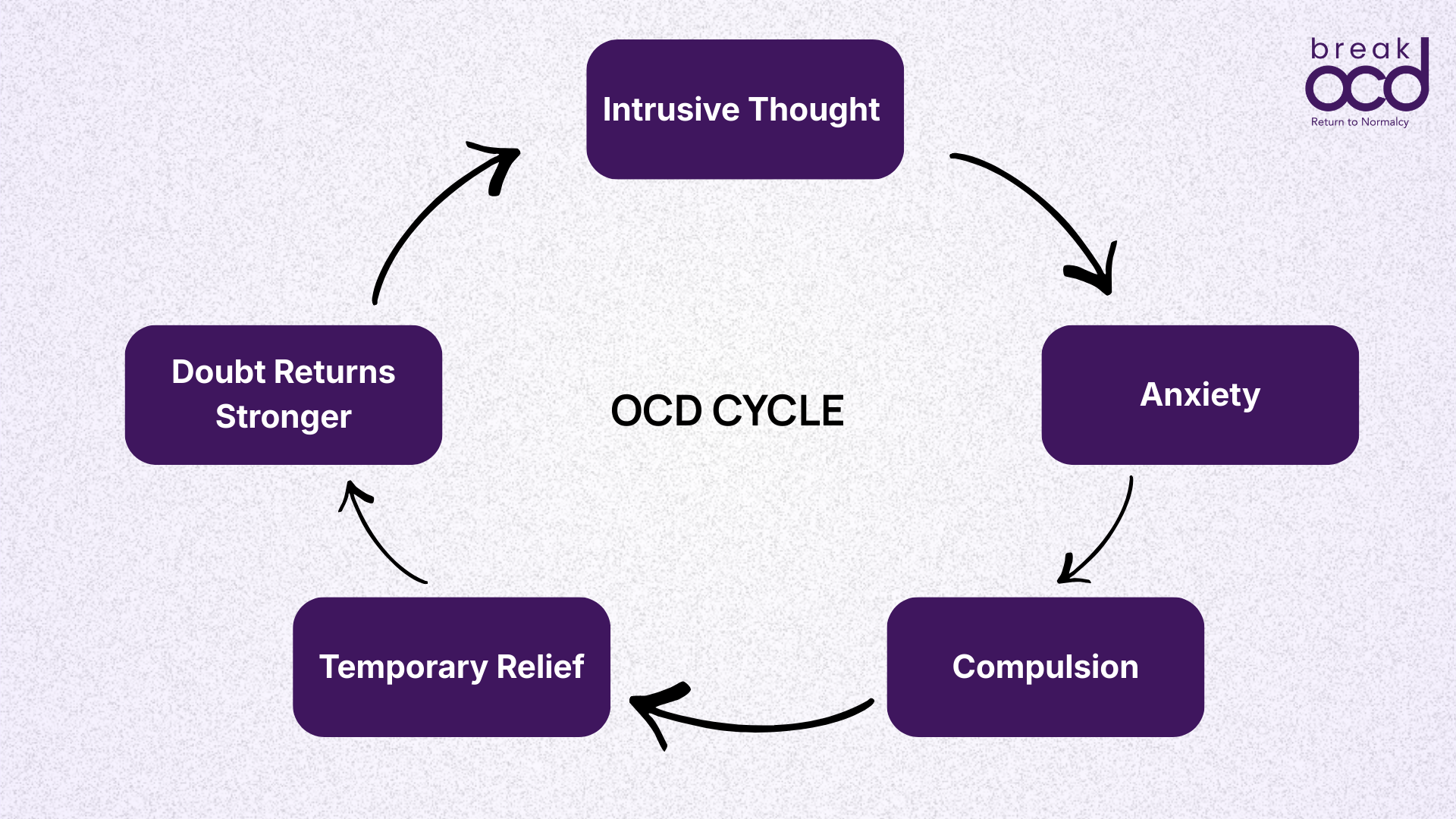
Avoidance is not safety. In OCD, every situation you avoid because of a feared thought becomes slightly more frightening. The world does not get safer. It gets smaller.
What This Fear Is Not
Because the content of these intrusive thoughts is so disturbing, it is worth being direct about several things this fear is not.
It is not a sign that you are dangerous. Research consistently finds that people with OCD are not at elevated risk of acting on intrusive thoughts. The fear and the distress are themselves protective. You are not a risk to the people around you.
It is not a sign that you secretly want to do the thing you fear. OCD thoughts are ego-dystonic, meaning they conflict sharply with your values and desires. The thought horrifies you precisely because you would never choose it.
It is not psychosis. People experiencing psychosis typically do not have insight into their condition. People with OCD have painful, exhausting insight into theirs. The person with OCD knows the thought is a thought. That distinction is clinically significant.
It is not a moral failing. You did not choose these thoughts and you cannot control their arrival. What you can change, with the right support, is how you respond to them.
It is not permanent. The fear of losing control in OCD is one of the most well-documented presentations of the condition and one of the most well-treated. People recover from this. Fully.
What Actually Helps
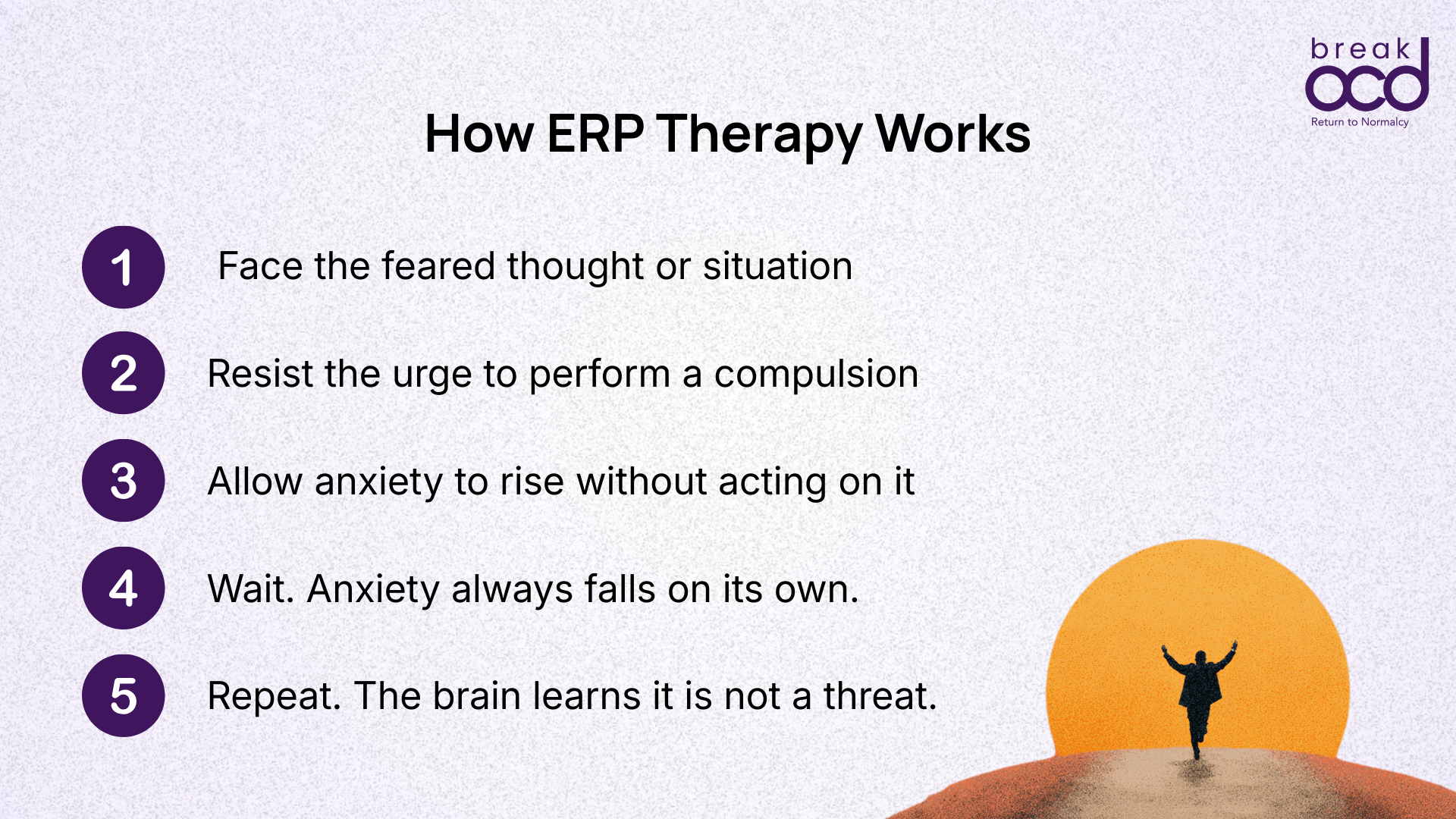
Exposure and Response Prevention therapy, ERP, is the gold-standard treatment for OCD including fear of losing control presentations. ERP works by gradually exposing the person to the thoughts and situations they fear while preventing the compulsive response, so that the brain learns over time that the thought does not lead to action, that uncertainty can be tolerated, and that the feared outcome does not occur.
For someone with harm-related or loss of control OCD, this might involve:
Allowing the intrusive thought to exist without analyzing it, neutralizing it, or seeking reassurance about it
Gradually approaching avoided situations, like being near a kitchen, driving, or being with a loved one
Writing or reading scripts that describe the feared outcome without compulsive responses
Resisting the urge to check, confess, or seek reassurance after an intrusive thought
The goal of ERP is not to prove that the feared outcome will never happen. Certainty is not the destination. The goal is to change the relationship with uncertainty itself, so that the absence of a guarantee no longer triggers the cycle.
Many people with OCD fear that doing ERP means accepting that they might actually act on their thoughts. This is a misunderstanding of how ERP works. ERP does not ask you to believe the thought is acceptable or that the outcome is possible. It asks you to stop responding to the thought as if it were an emergency, because it is not.
The research is clear. The clinical experience is consistent. People with fear of losing control OCD recover. The path forward is not to gain more certainty. It is to need less of it.
Frequently Asked Questions
Does having violent intrusive thoughts mean I am dangerous?
No. Research consistently shows that people with OCD who experience violent intrusive thoughts are not at elevated risk of acting on them. In fact, the opposite is clinically observed. The distress caused by these thoughts is itself evidence that they conflict with the person's values. People who genuinely intend harm do not experience the kind of horror and shame that characterizes OCD intrusive thoughts.
Why does the fear of losing control feel so real even though I know I would never act on it?
The fear feels real because OCD operates in the emotional systems of the brain, not the logical ones. Research has shown that the belief that thought leads to action is what makes the fear so powerful, not actual risk. When the brain appraises an intrusive thought as a potential command rather than a random mental event, it generates the same fear response as a genuine threat. Knowing the thought is irrational does not override that response. That is why ERP therapy, which changes the brain's learned response rather than arguing with the thought, is so much more effective than reasoning alone.
Is fear of losing control the same as harm OCD?
They overlap significantly but are not identical. Harm OCD specifically involves intrusive thoughts about harming oneself or others. Fear of losing control is a broader fear that appears across many OCD presentations, including harm OCD, sexual OCD, religious OCD, and social situations. It is the underlying belief that one cannot trust one's own mind or impulses, regardless of what specific outcome is feared.
Is it OCD or could I actually be dangerous?
This question is itself a very common OCD obsession, and seeking a definitive answer to it is a form of reassurance seeking. What is clinically important is the pattern: if you are experiencing unwanted intrusive thoughts that horrify you, spending significant time managing or responding to those thoughts, and finding that no amount of reassurance provides lasting relief, that pattern is consistent with OCD. A clinician who specializes in OCD is the right person to make a proper assessment.
Will ERP therapy make me confront my worst fears?
ERP is gradual and structured. It does not begin with the most frightening scenario. A trained ERP therapist builds a hierarchy of fears with you, starting with situations that cause manageable anxiety and progressing at a pace that is challenging but not overwhelming. The goal is never to prove that the feared outcome will not happen. It is to help the brain learn that uncertainty can be tolerated without a compulsive response.
Sources & Further Reading
NHS: Obsessive Compulsive Disorder Overview
Government of India: Rights of Persons with Disabilities Act 2016
Behaviour Research and Therapy: Beliefs about losing control, obsessions, and caution
Cognitive Therapy and Research: Fear of losing control in OCD and panic disorder (2025)
