
How Do I Know If I Have OCD? Signs, symptoms, and what OCD actually feels like from the inside
Written by Armaan Raheja, Founder of breakOCD | Clinically reviewed by Dr. Shorouq Motwani, Psychiatrist, Mumbai
In This Article
This question rarely comes from curiosity. It usually comes from exhaustion, confusion, or a quiet fear that something is wrong. If you are asking it, you are not alone.
Many people live with OCD for years without knowing what it is. In India, this gap is even wider. Most people first assume they are dealing with stress, overthinking, or anxiety. Others are told by well-meaning family members to simply think positively or pray harder. A few receive incorrect diagnoses, take the wrong medication, and wonder why nothing is helping.
This article will not diagnose you. But it will explain what OCD actually looks and feels like, how it differs from anxiety, what signs are most often missed, and when it may be time to speak to a professional.
Understanding what is happening is usually the first step toward getting your life back.
What OCD Actually Is
Obsessive Compulsive Disorder is a mental health condition involving two core components that feed each other in a cycle.
Obsessions are unwanted, intrusive thoughts, images, urges, or sensations that cause anxiety, discomfort, or doubt. They feel sticky, meaning they do not pass the way ordinary thoughts do.
Compulsions, commonly called rituals, are the mental or physical behaviors a person performs in response to that anxiety. They are attempts to feel safer, more certain, or to prevent something bad from happening.
The important thing to understand is that almost everyone experiences intrusive thoughts from time to time. A random dark thought, an uncomfortable image, an urge that surprises you. Most people notice it, find it strange, and move on without giving it much more attention.
For someone with OCD, the process looks much different. The thought gets caught. Instead of passing, it gets analyzed. The mind begins asking what the thought means, whether it says something about who you are, or whether you need to do something about it. Certainty is searched for, but it never fully arrives.
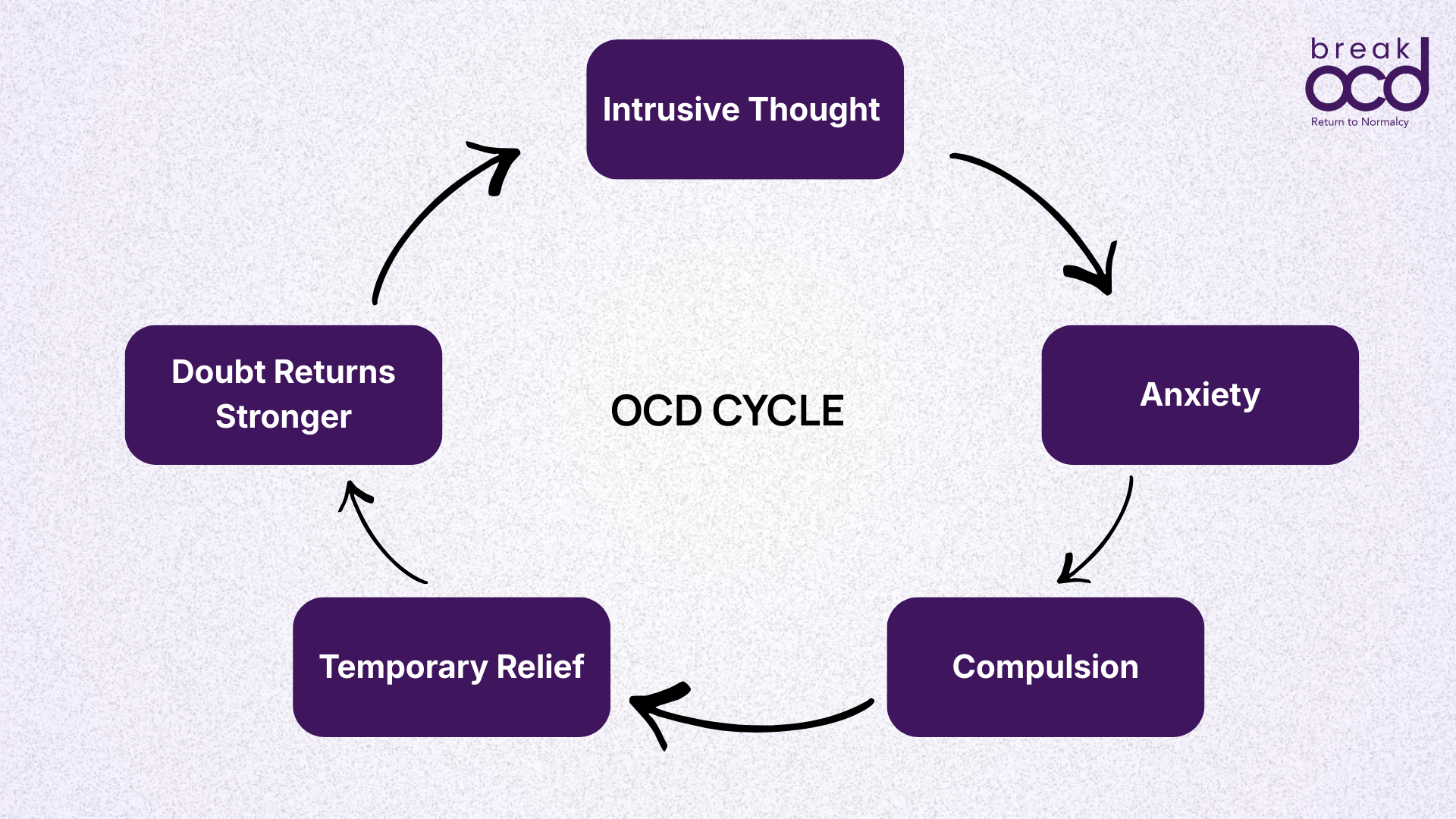
To reduce the anxiety, compulsions begin. These behaviors bring temporary relief, but over time, they reinforce the cycle because your brain comes to believe they are necessary, which makes the thoughts come back stronger.
The OCD cycle: Intrusive thought, anxiety or discomfort, compulsion, temporary relief, obsession returns stronger.
What OCD Feels Like from the Inside
OCD is not what most people imagine. It is not simply being neat, organized, or particular about cleanliness. The lived experience of OCD is often described as:
Feeling disturbed or frightened by your own thoughts
Constant doubt about your intentions, morality, or sense of reality
A crushing need for certainty before you can move forward
Fear that you might lose control or act on a thought you never chose to have
Feeling deeply responsible for preventing harm, even harm that is extremely unlikely
An exhausting internal monitoring of your own mind, all day long
What makes OCD particularly painful is that the intrusive thoughts are ego dystonic, which means they go directly against your values. If you care deeply about being a good person, your thoughts might target your morality. If your faith matters most to you, your thoughts may attack your relationship with God. If your family is everything, your thoughts may involve harm to them.
This is not a coincidence. OCD attacks what matters most. And because it targets what you love, the thoughts feel personal, even though they are not.
Signs of OCD That Are Commonly Missed
OCD is widely misunderstood, even by people who are living with it. Many people assume OCD only involves visible rituals like hand washing or checking locks. But a large number of people with OCD have few or no visible behaviors. Their compulsions happen entirely inside the mind.
Signs that often go unrecognized include:
Replaying conversations or events in your head to check if you said or did something wrong
Mentally reviewing situations repeatedly to make sure you did not cause harm
Googling symptoms, reassurance, or information obsessively to feel certain you are safe
Constantly checking your feelings or intentions to see if they are 'right'
Avoiding certain places, people, or situations 'just in case' something bad happens
Asking for reassurance from others repeatedly, even when they give it
Trying to suppress or neutralize unwanted thoughts with 'better' thoughts
Feeling intense guilt or a sense of responsibility for preventing bad outcomes
Mental rituals like praying, counting, or repeating phrases until they feel right
These behaviors feel completely logical in the moment. They feel like problem-solving, like being careful, like doing the right thing. This is exactly why so many people do not recognize them as compulsions.
Common OCD Themes in India
OCD can attach itself to almost anything that matters to a person. In India specifically, some themes appear with particular frequency due to cultural and social context. Note: These do not cover all the themes of OCD.
Religious OCD (Scrupulosity)
Given the deep importance of faith in Indian culture, religious OCD is extremely common. This can involve intrusive blasphemous thoughts, fear of offending God, feeling compelled to repeat prayers until they feel 'right,' or avoiding religious spaces out of fear.
Sexual Intrusive Thoughts
Unwanted sexual intrusive thoughts are among the most distressing and least talked about OCD themes in India. They can involve taboo content, thoughts about family members, children, or people of the same gender, and they carry enormous shame in a culture where sexuality is rarely discussed openly.
The most important thing to understand is that these thoughts say nothing about your desires or character. OCD targets what horrifies you most. The distress you feel about the thought is evidence that it goes against who you are, not evidence that it reflects who you are. Like all OCD themes, this responds well to proper treatment.
Harm OCD
Fear of accidentally or intentionally harming a loved one, a stranger, or oneself. The person with OCD is typically a gentle, caring individual who is horrified by these thoughts precisely because they go against everything they stand for.
Relationship OCD
Constant doubt about whether you truly love your partner, whether your relationship is right, or whether you are a good spouse or family member. This could be particularly common in the context of arranged marriages, where the stakes feel enormously high.
Contamination OCD
Fear of germs, illness, or spreading disease to others. While this may be what most people picture when they hear the word OCD, it is only one of many forms.
Moral and Existential OCD
Obsessive doubt about one's moral character, the meaning of life, or whether one's actions are truly ethical. These doubts loop without resolution and can feel completely paralyzing.
Pure O (Primarily Obsessional OCD)
A term used when compulsions are entirely mental and invisible to others. The person appears calm externally while experiencing intense internal rituals like mental reviewing, reassurance seeking, and rumination.
Is It OCD or Anxiety?
This is one of the most common questions, and the distinction genuinely matters because the treatment approaches are different.
Both OCD and anxiety involve worry, fear, and avoidance. But there are meaningful differences.
Anxiety tends to involve worries about real-world situations, and those worries, though painful, usually move on. The thought may return, but it does not typically loop in the same way.
OCD is defined by intrusive thoughts that feel stuck, combined with a powerful urge to perform mental or physical rituals to find certainty or relief. The loop does not end on its own. Each compulsion strengthens the cycle.
Another key difference: anxiety worries tend to feel plausible and realistic. OCD intrusive thoughts often feel ego-dystonic, meaning they clash sharply with your values, character, and sense of self. The thought horrifies you precisely because you would never want to act on it.
Why OCD Often Goes Undiagnosed in India
In India, OCD is significantly underdiagnosed for several reasons.
First, mental health awareness is still developing in many communities. Many people do not have the language to describe what they are experiencing, and 'OCD' is not a term that has entered everyday conversation the way it has in the West, except as a casual joke.
Second, family dynamics in India can unintentionally make OCD worse. When a family member seeks reassurance, loved ones naturally provide it. When someone avoids a situation, family members accommodate the avoidance. This is done out of love, but it quietly reinforces the OCD cycle.
Third, many people carry enormous shame and hide their thoughts entirely. Intrusive thoughts about harm, sexuality, or religion can feel too frightening or too embarrassing to share with anyone.
The result is that many people in India live for years, sometimes decades, not knowing that what they have is OCD, that it is recognized, and that it is highly treatable.
What OCD Is Not
Because OCD is so widely misunderstood, it is worth being direct about what it is not.
OCD is not about being neat or organized. Many people with OCD have no obsessions related to cleanliness at all.
OCD is not a quirky personality trait. Calling yourself 'so OCD' because you like a tidy desk is a misuse of the term and makes it harder for people with the real condition to be taken seriously.
OCD is not a sign that you want to act on disturbing thoughts. The opposite is usually true. People with OCD are typically deeply horrified by their intrusive thoughts.
OCD is not your fault. You did not choose these thoughts, and you are not defined by them.
When Should You Seek Help?
You do not need to wait until things become severe or unmanageable. Consider speaking to a mental health professional if:
You spend significant time managing fears, rituals, or reassurance seeking every day
Avoidance is affecting your work, studies, relationships, or daily activities
You feel exhausted from monitoring your own mind
Your quality of life is being impacted, even if things look fine from the outside
It is also worth noting that OCD is recognized as a disability under India's Rights of Persons with Disabilities Act, 2016. This reflects the real and serious impact it can have on daily functioning.
The Good News: OCD Is Treatable
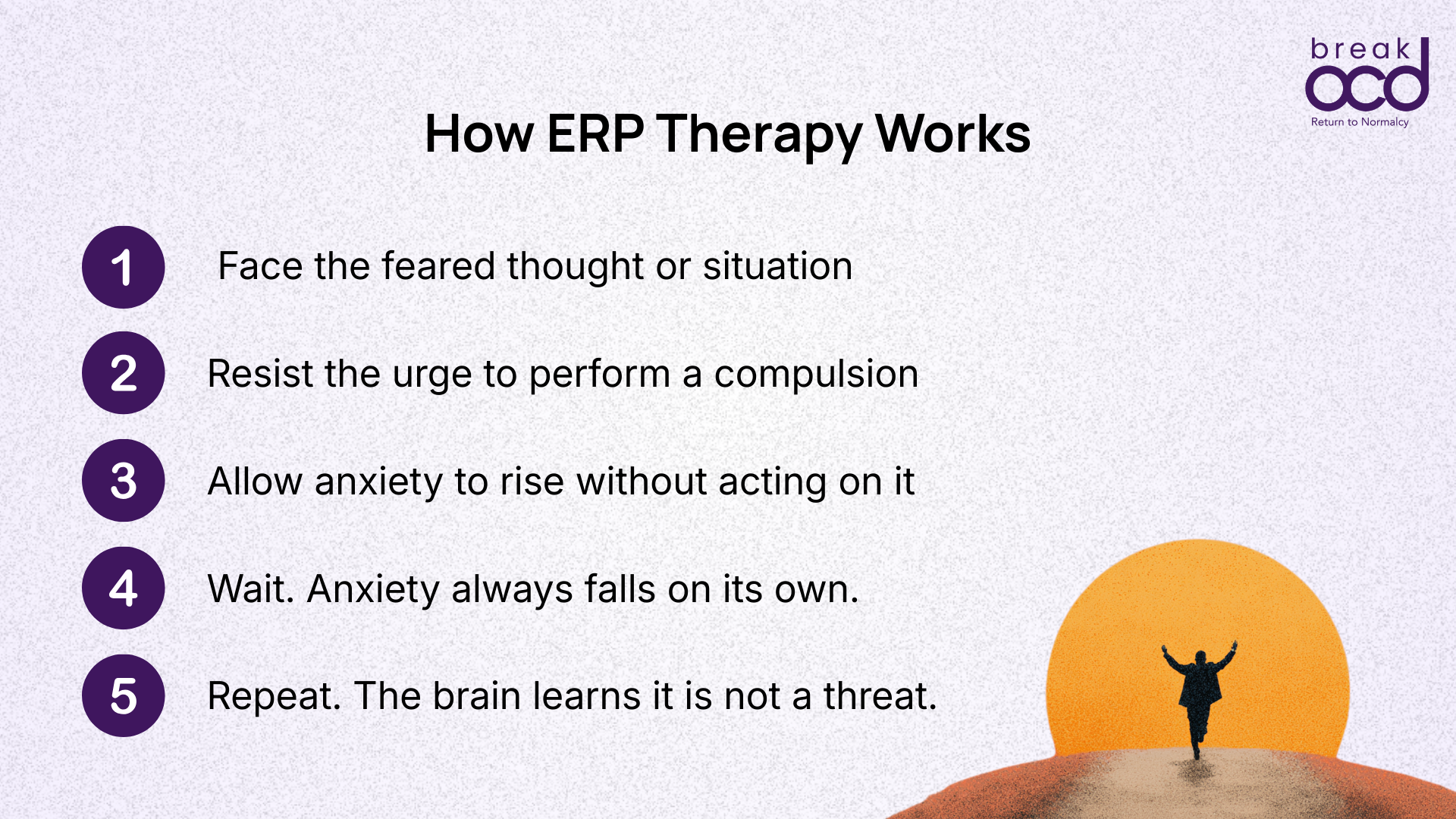
OCD is one of the most well-studied mental health conditions in the world. The gold-standard treatment is Exposure and Response Prevention therapy, or ERP. ERP works by helping people gradually face their feared thoughts and situations without performing compulsions, so that the brain learns the thoughts are not dangerous and do not require action.
Recovery does not mean never having intrusive thoughts again. Intrusive thoughts are a normal part of the human mind. Recovery means changing your relationship with those thoughts, so they no longer control your decisions, your relationships, or your life.
The path begins with understanding what is actually happening.
Frequently Asked Questions
Can you have OCD without visible rituals like hand washing or checking?
Yes. Many people with OCD have compulsions that are entirely mental and invisible to others. These include mentally reviewing events, seeking internal reassurance, ruminating on thoughts, and silently repeating phrases. This is sometimes called Pure O, though it is simply OCD in which compulsions happen in the mind rather than the body.
Is OCD different from being anxious or a worrier?
Yes. While both involve worry and discomfort, OCD is specifically defined by intrusive thoughts that feel stuck, combined with compulsive behaviors or mental rituals aimed at finding certainty or relief. Anxiety worries tend to move on. OCD loops. The relief from compulsions is always temporary, and the doubt always returns.
Can OCD have religious themes?
Yes. Religious OCD, also called scrupulosity, is one of the most common forms of OCD in India. It can involve blasphemous intrusive thoughts, fear of offending God, repeating prayers until they feel perfectly right, or avoiding religious rituals out of fear. The thoughts are unwanted and cause deep distress precisely because faith matters deeply to the person.
Why does OCD often go undiagnosed in India?
Several factors contribute. Mental health awareness is still developing in many communities. Shame and stigma prevent people from speaking openly about their thoughts. Family members who accommodate rituals and provide reassurance unintentionally maintain the cycle. And there are very few mental health professionals in India who specialize specifically in OCD, which leads to frequent misdiagnoses of anxiety or depression.
If I recognize these signs in myself, what should I do next?
Start by speaking to a mental health professional who has specific experience with OCD. General therapy and medication for anxiety or depression will not address OCD effectively.
About the Author
Armaan Raheja
Armaan Raheja is the founder of breakOCD, India's first dedicated OCD support app. He was diagnosed with OCD after years of misdiagnosis and went on to study psychology in the United States, where he received evidence-based treatment including ERP therapy. On returning to India and finding a fragmented mental health system with few OCD-specific resources, he built breakOCD to provide the support he wished had existed. Armaan brings both lived experience of OCD and a commitment to evidence-based, stigma-free mental health care in India.
Clinically Reviewed By
Dr. Shorouq Motwani
Dr. Shorouq Motwani is a Psychiatrist in Mumbai. She specializes in emotional and behavioral disorders, neurodevelopmental disorders, and mental health in adolescents. She is the recipient of the ASHA Award for best paper presentation and has multiple published research papers in psychiatry.
