
OCD and Medication: What to Know Before Starting Treatment in India
Written by Armaan Raheja, Founder of breakOCD | Clinically reviewed by Dr. Shorouq Motwani, Psychiatrist, Mumbai
- Why Medication Has a Role in OCD Treatment
- How SSRIs Work for OCD (And Why It Is Different From Depression Treatment)
- The Specific SSRIs Used for OCD
- When SSRIs Are Not Enough: Clomipramine and Augmentation
- Why Medication and ERP Work Better Together
- The Indian Context: Stigma, Family, and What Often Goes Wrong
- What to Expect When Starting Medication
- Common Myths About OCD Medication
- Frequently Asked Questions
You have heard medication described as a crutch. You have been told it changes who you are. You may have watched a relative start an SSRI, decide it did not work, and quietly stop within a month.
If you have OCD and you are weighing whether to take medication, the question deserves better than the inherited noise around it. The decision is yours and your psychiatrist's to make, but it should be made with information that reflects what the evidence actually says, not what your uncle, your school friend, or the internet has told you.
Medication is not a replacement for therapy. It is not a permanent label. It is not a sign that you have failed at trying harder. For many people with OCD in India, it is the difference between functioning and not functioning, between accessing ERP and being too consumed by symptoms to engage with it. For others, ERP alone is enough. The right answer depends on the severity, the specific presentation, and the resources available.
This article explains what medication does in OCD, which medications are evidence-based, what specifically gets done wrong in India, and what you should ask your psychiatrist before you begin.
Why Medication Has a Role in OCD Treatment
OCD is a neurobiological condition. The intrusive thoughts and compulsions that define it are not produced by weakness, by poor parenting, or by a lack of faith. They emerge from a brain whose threat-detection and habit-formation circuits — primarily involving the cortico-striato-thalamo-cortical loop and serotonin signalling within it — are misfiring in a specific, well-documented way.
Two evidence-based treatments target this mechanism. The first is Exposure and Response Prevention therapy, ERP, which teaches the brain through repeated experience that the feared outcome does not require a compulsion to manage. The second is medication, most commonly a selective serotonin reuptake inhibitor, which directly alters the serotonergic signalling involved in the OCD cycle.
The American Psychiatric Association, the NICE guidelines in the United Kingdom, the International OCD Foundation, and the Indian Psychiatric Society treatment guidelines all converge on the same recommendation. For mild to moderate OCD, ERP alone is the first-line treatment. For moderate to severe OCD, the combination of ERP and an SSRI produces meaningfully better outcomes than either approach alone. For severe OCD that is interfering with the person's capacity to engage with therapy at all, medication is often the right place to start, with ERP introduced once symptoms have eased enough to allow it.
The role of medication is not to silence intrusive thoughts. It is to lower the volume of the OCD response enough that the work of ERP becomes possible, and to reduce the underlying symptom severity in a way that ERP alone may not achieve in moderate to severe cases.
Medication does not eliminate intrusive thoughts. It reduces the intensity of the OCD response, making the work of ERP possible for many people who otherwise could not engage with it.
How SSRIs Work for OCD (And Why It Is Different From Depression Treatment)
This section is one of the most important in this article, because it is the place where OCD treatment in India most often goes wrong.
SSRIs were originally developed for depression. They are also evidence-based for OCD, but the way they are used for OCD is meaningfully different in three specific ways that many general practitioners and even some psychiatrists outside specialist settings get wrong.
The dose is higher
OCD typically requires SSRI doses at the upper end of the prescribing range, and often higher than what is used for depression. Fluoxetine for depression is often prescribed at 20 mg per day. For OCD, the evidence-based dose can range from 40 to 80 mg per day. Sertraline for depression may be 50 to 100 mg per day. For OCD, doses up to 200 mg per day are common. If an OCD patient is given a depression-level dose, the medication may fail to produce a response, and the patient is left believing medication does not work for them. This is not a failure of the medication. It is a failure of dosing.
The trial is longer
SSRIs in depression typically begin to show meaningful effect within four to six weeks. In OCD, the response can take ten to twelve weeks or longer at the appropriate dose. A four-week trial that would be sufficient for depression is too short to conclude that an SSRI is not working for OCD.
Symptom reduction is the goal, not symptom elimination
A successful SSRI trial in OCD is often defined as a 25 to 35 per cent reduction in symptom severity. Many people expect medication to make intrusive thoughts disappear and consider anything less to be failure. A meaningful reduction in OCD severity, combined with ERP, is what actually changes a person's life.
These three points — dose, duration, and the goal — are the difference between a medication trial that fails and a medication trial that works. They are also the points most likely to be missed when OCD is treated outside specialist settings.
OCD typically requires higher SSRI doses than depression, taken for longer before judging effect. A four-week trial at a depression-level dose is not a real trial for OCD.
The Specific SSRIs Used for OCD
Six medications have the strongest evidence base for OCD treatment. They are not identical to each other in how they are tolerated, but the evidence for their efficacy in OCD is broadly similar. The choice between them is typically made based on side-effect profile, interaction with other medications, and individual response.
The SSRIs with the strongest evidence in OCD are fluoxetine, sertraline, fluvoxamine, paroxetine, escitalopram, and citalopram. Of these, fluoxetine, sertraline, fluvoxamine, and paroxetine have specific regulatory approval for OCD in many countries.
A psychiatrist will typically begin with one of these at a low dose, increase gradually to monitor side effects, and arrive at a therapeutic dose for OCD over a period of weeks. Side effects are most common in the first two to four weeks and frequently improve as the body adjusts.
Common early side effects include nausea, headache, sleep disruption, mild gastrointestinal symptoms, and a temporary increase in anxiety. Sexual side effects, including reduced libido or delayed orgasm, occur in a meaningful proportion of people and can persist beyond the early period. These should be discussed openly with your psychiatrist. They are not something to be tolerated silently, and a switch to a different SSRI often resolves them.
When SSRIs Are Not Enough: Clomipramine and Augmentation
Roughly 40 to 60 per cent of people with OCD respond well to a first SSRI trial. The remainder may require a different approach. Not responding to the first medication is not the end of the road. There is a clear next step, and a psychiatrist familiar with OCD will know what it is.
A second SSRI at full dose for the full duration may produce a response where the first did not. If two adequate SSRI trials have not produced sufficient response, the next evidence-based option is typically clomipramine.
Clomipramine is a tricyclic antidepressant with strong serotonergic effects. It has been used for OCD since the 1980s and remains one of the most effective single medications for the condition. It is often more potent than SSRIs for OCD, but its side-effect profile is also more pronounced, including dry mouth, constipation, drowsiness, and cardiac effects that require monitoring. For these reasons it is usually a second-line option, considered when SSRIs have not produced sufficient response.
For OCD that remains severe despite adequate SSRI or clomipramine treatment, psychiatrists may add a second medication to augment the effect. The most common augmentation strategy is the addition of a low-dose atypical antipsychotic, such as risperidone, aripiprazole, or olanzapine. The evidence here is meaningful but more modest, and augmentation is a clinical decision that requires a psychiatrist experienced in treatment-resistant OCD.
This stepped approach — first SSRI, second SSRI, clomipramine, augmentation — is the standard pathway recommended by international and Indian treatment guidelines.
Why Medication and ERP Work Better Together
The strongest outcomes in OCD treatment come from combining medication with ERP. The two approaches work on different parts of the same problem, and they reinforce each other in ways that either alone cannot.
Medication reduces the underlying severity of the OCD response. It lowers the volume of the intrusive thoughts, the intensity of the anxiety, and the urgency of the compulsion. This does not eliminate OCD. It creates the conditions in which therapeutic work becomes possible.
ERP teaches the brain a new lesson: that intrusive thoughts do not require a compulsive response, and that anxiety rises and falls on its own without intervention. This work is hard at any level of severity, but it is significantly harder when symptoms are at their most intense. Medication does not do the work of ERP. It makes the work of ERP achievable.
This is why many patients who initially respond well to medication report that the gains feel incomplete without therapy, and why patients who attempt ERP without medication in severe OCD often find the work too overwhelming to sustain. The combination is not a doubling of effort. It is two distinct treatments addressing the same condition from different angles.
For mild OCD, ERP alone is typically sufficient. For severe OCD, medication is often the right place to begin, with ERP layered in once symptoms allow it. For moderate OCD, the choice depends on the person's preferences, resources, and clinical presentation. A psychiatrist and psychologist working together, ideally one trained specifically in OCD, are best placed to make this decision with the patient.
The Indian Context: Stigma, Family, and What Often Goes Wrong
The decision to take psychiatric medication in India is rarely a private one. It typically involves family, sometimes extended family, and frequently a layer of cultural belief about what mental illness is, what medication does, and what taking it says about a person.
The stigma is structural
Psychiatric medication in India is still widely understood as something for severe mental illness, for people who have broken down, for those who could not cope on their own. The idea that medication is a routine, evidence-based treatment for a specific neurobiological condition has not penetrated public understanding to anything like the same degree as, for example, medication for hypertension or diabetes. A person who tells their family they are starting an SSRI for OCD is often met with concern that is genuine but uninformed.
The family pushback is common
Many people with OCD in India describe being pressured by parents, spouses, or siblings to try harder, to have more faith, to not depend on a pill. The pressure is rarely cruel. It is rooted in love and in a cultural belief system that views medication as either unnecessary or dangerous. But the result is that many people start medication and stop within weeks, before any therapeutic effect could possibly have been achieved, because the family has decided the medication is the problem.
The clinical handling often gets the OCD-specific details wrong
General practitioners and psychiatrists outside specialist settings frequently prescribe SSRIs at depression-level doses, evaluate the trial at four to six weeks, and conclude that medication does not work for the patient. The patient is then often switched to a different medication at the same insufficient dose, or told that their case is treatment-resistant when in fact they have never had an adequate trial.
The cost and access barrier is real
Many families cannot easily access an OCD-specialist psychiatrist. The patient may see a general psychiatrist for an initial consultation, a follow-up that is too brief, and a prescription written without a clear treatment plan. This is not the fault of any individual clinician. It is a structural problem in how psychiatric care is delivered in much of India, and it directly affects whether OCD medication works.
What this means in practice
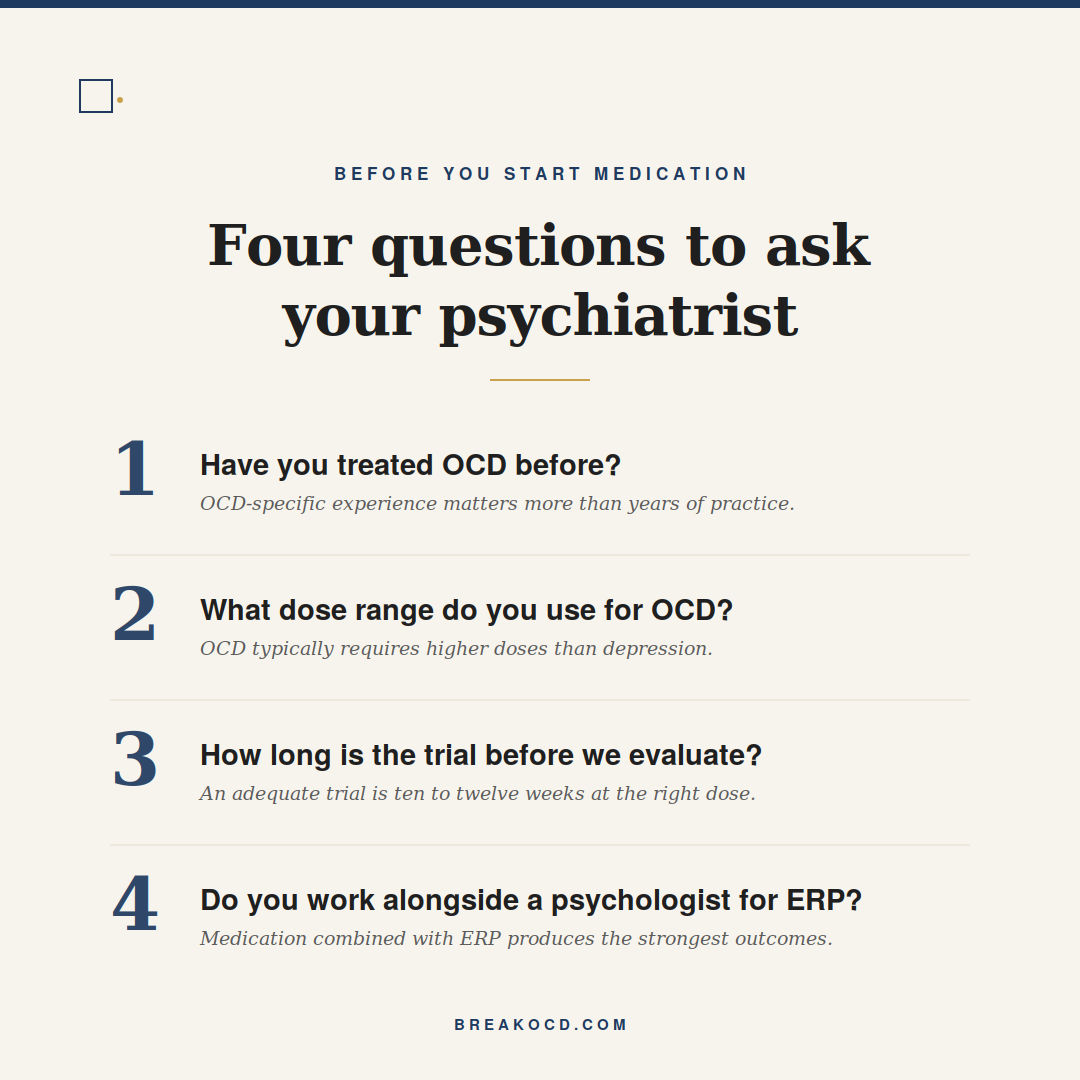
If you are considering medication for OCD in India, the most important step is finding a psychiatrist with specific OCD experience. Ask directly whether they have treated OCD before. Ask what dose range they typically use for OCD. Ask how long the trial will last before evaluating response. Ask whether they work in collaboration with a psychologist for ERP. The answers to these questions will tell you more than any review or recommendation about whether this clinician will treat your OCD appropriately.
If your psychiatrist will not tell you what dose range they use for OCD, how long the trial will last, or whether they work alongside ERP therapy, you have not yet found the right psychiatrist.
What to Expect When Starting Medication
The first few weeks on an SSRI are a settling-in period. Many people tolerate the medication well from the start. Others notice some mild adjustment effects in the early days as the body gets used to the medication, and a smaller proportion experience side effects that need clinical attention. The experience is individual, and the early period is best navigated with regular communication with your psychiatrist rather than with expectation of a fixed timeline.
If and when side effects do appear, they are usually short-lived. Mild gastric symptoms such as nausea or loose stools often settle within a few days as the body adjusts. Other adjustment effects, such as headache, sleep disruption, or a brief increase in anxiety, typically ease within two to four weeks. The therapeutic effect on OCD itself usually becomes noticeable between weeks six and ten, sometimes later, and continues to build over the following months. Improvement is gradual rather than sudden, which can make it hard to perceive in real time. Many patients describe the realisation that medication is working not as a dramatic moment but as a slow recognition that the OCD response is less urgent, the compulsions less compulsory, the thoughts less consuming.
During this period, regular follow-up with your psychiatrist matters. Side effects, if they appear, should be reported and managed rather than tolerated. Dose adjustments should be made on the basis of evidence and your response, not on the basis of family pressure or impatience. If you are also doing ERP, your therapist should be aware that you are on medication, and your psychiatrist should ideally be aware of your ERP work. The two treatments inform each other.
Discontinuation, if and when it happens, should be gradual and supervised. SSRIs are not addictive in the sense that opioids or benzodiazepines are, but stopping them abruptly can produce a discontinuation syndrome with physical and psychological symptoms that can be uncomfortable. A psychiatrist-supervised taper, typically over weeks or months, prevents this.
Common Myths About OCD Medication
"SSRIs are addictive"
They are not. SSRIs do not produce the dopaminergic reward response that defines addiction, and stopping them does not produce drug-seeking behaviour. They can produce a discontinuation syndrome if stopped abruptly, which is uncomfortable but distinct from addiction. A gradual taper resolves it.
"Medication will change who I am"
A successful SSRI trial in OCD does not alter personality. It reduces the intensity of OCD symptoms. Patients consistently describe feeling more like themselves on medication, not less, because the OCD is no longer dominating their thinking. Personality changes are not a known effect of SSRIs at therapeutic doses.
"If I start, I will be on it forever"
Some people stay on SSRIs long-term. Many do not. The decision about duration is made between patient and psychiatrist on the basis of symptom severity, response, history, and personal preference. For many people, an SSRI is taken for one to two years alongside ERP, then tapered with continued monitoring.
"It is a crutch. I should be able to manage on my own"
This framing treats OCD as a problem of effort or willpower. OCD is a neurobiological condition, and medication addresses one specific component of that biology. Taking it is not a moral failure. It is using an evidence-based treatment for an evidence-based condition.
"If the medication does not work in a month, it is not for me"
This is the single most common and most damaging myth about OCD medication. Medication for OCD requires ten to twelve weeks at the appropriate dose before its effect can be evaluated. Stopping at four weeks because nothing has changed is not a fair trial. It is an incomplete one.
Frequently Asked Questions
How long does it take for OCD medication to work?
The therapeutic effect of an SSRI in OCD typically emerges between weeks six and ten, with continued improvement over the following months. A four-to-six-week timeline, which is typical for depression, is not sufficient to evaluate the response of OCD to medication. An adequate trial is generally considered to be ten to twelve weeks at the upper-range therapeutic dose.
Do I have to take medication forever?
Not necessarily. The duration of treatment is a decision made between you and your psychiatrist based on the severity of your OCD, your response to medication, and your individual circumstances. Many people take medication for one to two years alongside ERP and then taper off with continued monitoring. Some people remain on medication longer, particularly if previous attempts to taper have resulted in symptom return. The decision is personal and clinical, not automatic.
Can I do ERP without medication?
Yes. For mild to moderate OCD, ERP alone is often sufficient and is the first-line recommendation. For more severe OCD, medication can make ERP achievable where it would otherwise be too overwhelming to sustain. The decision depends on severity and personal preference and should be made with a clinician experienced in OCD.
My doctor put me on an SSRI but it did not work. Does that mean medication is not for me?
Not necessarily. The most common reason an SSRI trial fails in OCD is that the dose was too low or the trial was too short. OCD typically requires higher doses than depression and a longer trial period before response can be evaluated. Before concluding that medication does not work for you, ask whether the dose was in the OCD therapeutic range and whether the trial lasted at least ten to twelve weeks. If not, you have not yet had a real trial.
Are SSRIs safe during pregnancy?
This is a decision that must be made with both a psychiatrist and an obstetrician. Some SSRIs are considered relatively safer during pregnancy than others, and the decision involves weighing the risks of medication against the risks of untreated OCD, which has its own significant effects on maternal and infant outcomes. Stopping medication abruptly because of pregnancy without clinical guidance is not safe. A planned, supervised conversation before or early in pregnancy is the right approach.
What if my family does not want me to take medication?
Family resistance to psychiatric medication is one of the most common barriers to OCD treatment in India. The most useful approach is education. Many families soften their position when they understand that OCD is a neurobiological condition, that the medication is evidence-based, and that the treatment plan has been made by a qualified psychiatrist. Some families do not change their position. In that case the decision remains yours, and the clinical recommendation should be made on clinical grounds, not on the basis of family pressure. A psychiatrist who works frequently with Indian families is often skilled at helping have this conversation.
Sources
American Psychiatric Association. Practice Guideline for the Treatment of Patients with Obsessive-Compulsive Disorder. Arlington, VA: American Psychiatric Publishing; 2007. psychiatryonline.org/pb/assets/raw/sitewide/practice_guidelines/guidelines/ocd.pdf
American Psychiatric Association. Diagnostic and Statistical Manual of Mental Disorders, Fifth Edition, Text Revision (DSM-5-TR). American Psychiatric Publishing; 2022.
National Institute for Health and Care Excellence. Obsessive-compulsive disorder and body dysmorphic disorder: treatment (CG31). London: NICE. www.nice.org.uk/guidance/cg31
Soomro GM, Altman DG, Rajagopal S, Oakley-Browne M. Selective serotonin re-uptake inhibitors (SSRIs) versus placebo for obsessive compulsive disorder (OCD). Cochrane Database of Systematic Reviews. 2008;(1):CD001765. pubmed.ncbi.nlm.nih.gov/18253995
Janardhan Reddy YC, Rao NP, Khanna S. An overview of Indian research in obsessive compulsive disorder. Indian Journal of Psychiatry. 2010;52(Suppl 1):S200-S209. pmc.ncbi.nlm.nih.gov/articles/PMC3146215/
International OCD Foundation. Medications for OCD. iocdf.org/about-ocd/treatment/meds/
Pittenger C, Bloch MH. Pharmacological treatment of obsessive-compulsive disorder. Psychiatric Clinics of North America. 2014;37(3):375-391. pubmed.ncbi.nlm.nih.gov/25150568
Janardhan Reddy YC, Sundar AS, Narayanaswamy JC, Math SB. Clinical practice guidelines for Obsessive-Compulsive Disorder. Indian Journal of Psychiatry. 2017;59(Suppl 1):S74-S90. pmc.ncbi.nlm.nih.gov/articles/PMC5310107/
Disclaimer: This article is for educational purposes and is not a substitute for medical advice. Decisions about medication should be made with a qualified psychiatrist who knows your individual history.
